

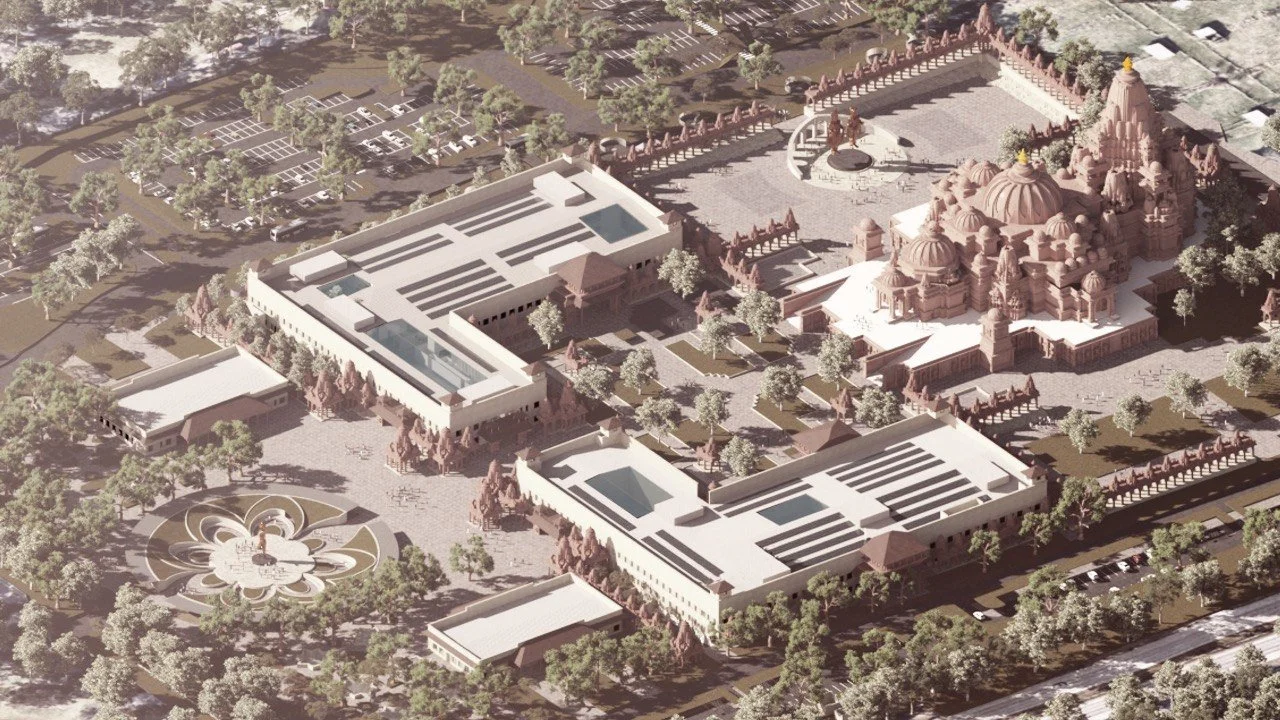

BAPS Hindu Mahã-Mandir
Place of Worship, Cranbourne South
Project Update: Permit Application Submitted – July 2026
BAPS Swaminarayan Sanstha, Australia (BAPS) has officially submitted our Permit Application to the Department of Transport and Planning (DTP) through the Development Facilitation Program (DFP). This submission follows a rigorous preliminary phase, during which the project’s design was refined through detailed technical and environmental assessments.
We understand the community is interested in this proposal, and we are committed to keeping you informed. With the Permit Application now submitted, we are working on different ways of sharing regular updates and staying connected with the local residents and relevant stakeholders. We will share more information on this through this website as soon as they are finalised. In the meantime, you are welcome to contact us via our website.
About the project
BAPS proposes to develop a new Hindu Mahã-Mandir (place of worship) at 1390–1450 Western Port Highway, Cranbourne South. The site has been carefully selected for its suitability to the community’s needs, its location at the urban–rural interface, and its close connection to the natural environment. The City of Casey currently accommodates one of the most diverse communities in Victoria, making it a highly appropriate location for the proposed development.
This BAPS Hindu Mahã-Mandir is proposed to be a unique cultural project for BAPS with a place of worship that includes gardens, landscaping and ancillary uses. Mandirs are the central sites for the Hindu religion for religious practice and cultural activities. All will be welcome to visit BAPS Hindu Mahã-Mandir which will serve both the faithful and the wider community as a cultural and religious hub.
Who is BAPS?
BAPS Swaminarayan Sanstha is a Hindu organisation. In Australia, BAPS has been part of community life for more than three decades, growing to include 19 mandirs and 84 centres where families gather for prayer, learning, and service.
The BAPS community is made up of families, students, working professionals, children, and seniors. What draws people together is a shared belief that spirituality should express itself through good character and care for others, both within our own community and beyond it.
At the heart of BAPS is a guiding principle: In the joy of others lies our own.
Everything BAPS does in Australia is powered by volunteers. There are no paid staff running community programs, but individuals and families who give their time because they believe in the value of service.
This spirit of contribution, known in the Hindu tradition as seva, is not unique to BAPS. It’s the same ethos that drives volunteer firefighters, community sports coaches, and neighbours who drop off meals when someone is unwell. BAPS simply provides a framework and a community for people who want to serve.
The potential process and the community
This proposal has been submitted through the Development Facilitation Program (DFP) with the Victorian Department of Transport and Planning (DTP). The DFP is an approval pathway through the State Government for projects that deliver investment into the Victorian economy, keep people in jobs and provide a public benefit. Local councils are consulted through this process, however, the Minister for Planning makes the final decision.
Community consultation about the proposal will be a critical aspect of the submission as it progresses. Community members will be informed about the proposal as it progresses and have an opportunity to make a submission through the formal process outlined by DTP.
Submit a question for BAPS project team
BAPS welcomes your questions and will endeavour to respond promptly via the FAQs section on this website.
FAQs
-
Timelines for this proposal are indicative and may change depending on the application and progression. BAPS will continue to review timelines and provide updates via this website as the process advances to ensure the community is kept up to date.
EPBC submission lodged with the Federal Government, Department of Climate Change, Energy, the Environment and Water.
EPBC submission withdrawn
Permit Application submitted to the Department of Transport and Planning
-
Are there benefits to the local community?
The goal of a place of worship is to build a cultural hub where Hindus can share their traditions and religion and connect with the wider community.
BAPS Hindu Mahã-Mandir will offer:
a place of worship.
educational and immersive experiences about Hinduism, promote cultural diversity and acceptance, and support the growing Indian and Hindu population in the area.
creation of local jobs through construction and boost local businesses by attracting visitors to the area.
enhance community health and well-being by providing a range of spaces, facilities, and services that support physical, mental, cultural, and spiritual well-being while promoting social connections and inclusivity.
a cultural space that enhances and diversifies the region's cultural offerings through unique attractions, events, and activities.
community initiatives such as tree planting, blood donation drives, Clean Up Australia Day events, charity walkathons, disaster relief, and support for vulnerable community members.
Will I be allowed to visit the place of worship?
Yes. This place of worship will be built by the community for the community, embracing the belief that all people, regardless of background, are welcome. Hinduism is a non-proselytising faith and anyone can come visit and learn about Hinduism and our culture including locals, visitors and school groups.
What will the opening hours be?
Opening hours will be determined through the planning approval process.
How many people are expected to visit?
Final visitor numbers will be confirmed through the planning approval process.
How can I join this project?
We are heartened by the strong interest from the community in being part of this unique project, and we welcome this spirit of collective support.
As the project progresses, opportunities to be involved will be shared. We encourage you to stay connected through this website to receive updates as the project continues to unfold.
-
How and when will the community be engaged?
Engagement with the local community is an essential part of the process. Now that the Permit Application has been submitted, we are working on different ways of sharing regular updates and staying connected with the local residents and relevant stakeholders. We will share more information on this through this website as soon as they are finalised. In the meantime, you are welcome to contact us via our website.
Are you receiving any government funding?
The project does not receive any funding from local, State or Federal governments. The project is funded entirely through voluntary contributions from members of the Australian community.
Why was this proposal on the DCCEEW website?
It is common practice for applicants to seek preliminary advice from relevant authorities before lodging a planning application. The listing on the DCCEEW website was part of a preliminary environmental referral process under the Environment Protection and Biodiversity Conservation Act 1999 (EPBC Act). It is not a formal planning application. In February 2026, it was determined that the EPBC process is no longer required, and subsequently the EPBC application was withdrawn.
-
What environmental studies will or have you done?
Both an arborist and ecologist were engaged to provide technical inputs regarding the master planning phase of the project. Their findings have ensured native vegetation, habitat opportunities and revegetation were appropriately factored into the submitted development design, reflecting the high importance of retaining and improving biodiversity values in the area. The reports prepared by the environmental experts were submitted as part of the Permit Application.
How will you protect and enhance the natural environment?
Ongoing engagement regarding native vegetation and biodiversity will continue to occur between the relevant authorities and the project team to ensure the site design can positively contribute to the local flora and fauna. A Land Management Plan, Wildlife Management Plan, Flora and Fauna Assessment, and Landscape Design Report have been submitted as part of the Permit Application.
Are you allowed to build in the green wedge?
In Victorian Planning law, Places of Worship are a permissible land use and development within the Green Wedge Zone, to be contemplated through a planning permit application process.
The proposed design, which has now been submitted as part of our formal Permit Application, was carefully developed to protect and enhance the local environment where possible including green spaces, landscape and protection of remnant bushland. This project has included extensive consultation with environmental experts, specialist consultants and relevant government bodies. These steps are made to ensure that all environmental and planning considerations for the Green Wedge Zone are addressed responsibly.
-
Where is the proposed location?
The proposed site for this development is 1390–1450 Western Port Highway, Cranbourne South.
Why is this the proposed location?
The site has been carefully selected for its suitability to the community’s needs, its location at the urban–rural interface, and its close connection to the natural environment. The City of Casey currently accommodates one of the most diverse communities in Victoria, making it a highly appropriate location for the proposed development.
Will there be access for people with disabilities?
Yes. The site has been designed with inclusion in mind, to support people with a range of access needs. This includes (but is not limited to) step-free access for those using wheelchairs or with reduced mobility, as well as accessible parking.
Accessibility considerations will continue to guide planning and design as the project progresses.
-
How are you working with Traditional Owners?
As part of the Permit Application, BAPS will prepare an Aboriginal Cultural Heritage Management Plan and is working in partnership with the Bunurong Land Council to inform the design and other aspects of the project.
-
How will you plan for changes in traffic flow?
A traffic engineer has been engaged from project inception to provide technical inputs to the project, this has included but is not limited to safe access and egress to and from the site; number of carparking spaces required to support anticipated visitor numbers; onsite vehicle management; and opportunities for alternative traffic management options.
Engagement with relevant statutory stakeholders, State and Local Government, will ensure that all relevant matters are considered and to ensure the site can function in a safe and efficient manner, and to limit off-site impacts.
What provisions are being made for public transport, cycling, and pedestrian access?
We believe that access and connectivity to the site should be respectful of both environmental and community needs. As the application progresses, we will work closely with local and state government to explore and implement initiatives that improve access for all visitors, including sustainable and active transport options.
-
How does BAPS plan to build such a large and unique structure?
We believe that the right consultants, architects, and contractors based here in Melbourne combined with the dedication of our volunteers and experienced project teams, can thoughtfully and responsibly deliver this project. This confidence is informed by experience gained through delivering and managing major community and cultural projects across Australia, supported by staged planning and careful governance.
Does BAPS pay rates?
BAPS complies with all requirements set by relevant authorities, including the payment of applicable rates and charges.
BAPS Introduction
Meet BAPS, the community and the communities they wish to serve.
Community Contribution

BAPS proudly and respectfully acknowledges the Bunurong people, the traditional owners of the lands and waterways. As a gesture of respect, and in recognition of the enduring cultural contribution and custodianship of the Bunurong people, we share the following Sanskrit expression drawn from a classical language foundational to Hindu thought to honour the principle of continuity and care for land that resonates across cultures: सदादिवासिनो भूमिर् आसिदियं भविष्यति - Always Was, Always Will Be Aboriginal Land.