
Communities of Practice
Outside of delivering high quality community engagement, Conversation Co loves the opportunity to build the capacity of organisations to deliver community engagement. We use a wide range of methods to do this include formalised training, one-off workshops, placing staff within organisations through Conversation People and developing communities of practice (CoP).
A CoP is a group of people who share a common interest, aspiration or set of problems. The CoP meets regularly to deepen their knowledge and improve their practice. These groups facilitate collective learning, knowledge sharing, and collaborative problem-solving, helping to build skills and create new approaches in areas like public engagement, social enterprise, or urban planning.
Some of the participant benefits of CoPs include:
Improving practice and increasing knowledge by providing a platform for professionals to share best practice, ask questions, and support each other, leading to better outcomes in their work.
Developing support by fostering a sense of community and providing opportunities for networking and mentoring among professionals. This is particularly beneficial for those who may work solo (including a lot of community engagement roles).
Identifying opportunities for partnerships and better utilising resources through working together and avoiding duplication of efforts
Avoid community fatigue. When practitioners talk to each other, they coordinate efforts, align messaging, and avoid accidental overlap or repeated asks—ultimately reducing friction and frustration among community members.
Creates a home for practitioners. Early-career specialists get mentorship; experienced staff have a peer group to calibrate with; everyone gets a community to fall back into.
Some of the challenges we have faced when developing CoPs:
Establishing the role of facilitator when interacting with experts- this is where we need to be clear that we are there to develop frameworks to keep the CoP meaningful, but not telling experts what to do!
Prioritising staff attendance- we can see participation drop off over time, it is important to communicate what values the CoP may bring to the organisation and participants. It is also crucial to regularly review the model with input from participants.
Lack of clarity- if there is no clear goal or purpose from the group- this can lead to quick drop off in the group.
Some of the tips we have for successful CoPs:
Engage prior to the CoP, talk to professionals on what they think CoP is and why it may be needed.
Co-design the CoP with participants including being very clear on the purpose of the group and creating the format (e.g. how often, when, how long). Keep it simple!
Have regular check-in points to see whether the CoP is still meeting a need. Be clear on the outcomes and achievements of the CoP and share this!
Allow anonymous feedback, offer Menti polls or anonymous surveys to collect feedback on the CoP.
Victorian Health Promotion Foundation CoP
Conversation Co partnered with Victorian Health Promotion Foundation (VicHealth) to establish and facilitate a Community of Practice (CoP) with LPHUs across the state to strengthen staff capability in planning and delivering community engagement. The CoP brought together staff involved in delivery of Prevention and Population Health projects across 6 LPHUs who often work in isolation, creating a shared space for connection, learning and collaboration. Importantly, this CoP was developed for officer level staff to provide a peer-led network of support for health planning, building skills and sharing ideas, partnering for advocacy pieces and replicating work.
-
Conversation Co facilitated a series of co-design workshops to define the group’s purpose, scope and expectations. Staff used Menti polls, small-group discussions and mapping of projects and communities to identify current challenges, confidence levels and learning priorities.
From this, we drafted a Code of Practice, Terms of Reference and designed a seven-session program enabling staff to take on a session in a group and facilitate something their team were interested in gathering feedback, support on. In the co-design sessions, the group landed on a simple structure: ‘Share, Discuss, Apply’ for their sessions.
Conversation Co provided resources for planning, inspiration for formats, data collection, reporting back and technical support to enable LPHU staff to develop their own facilitation and engagement skills whilst participating in their CoP.
After several rounds of CoP sessions followed by participant evaluations and tweaks we landed on a good formula for the group to pick up and use. We then stepped out of the CoP, leaving it in their capable hands to continue.
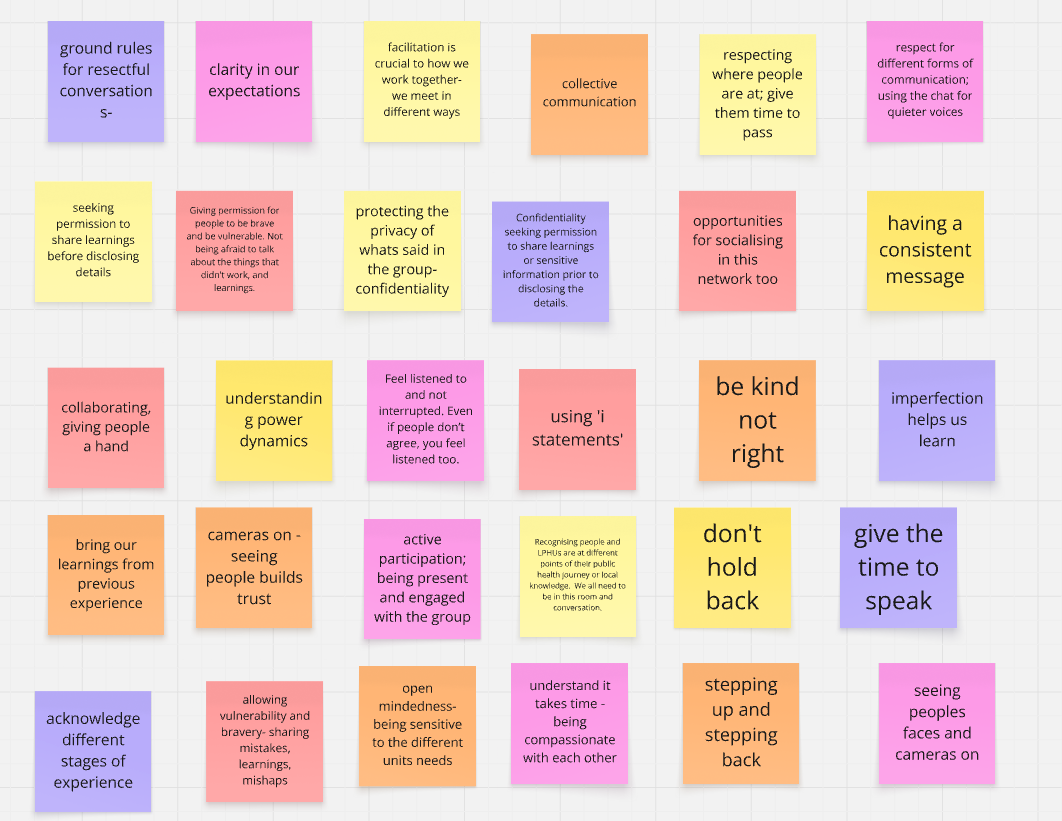
Example: building a code of practice, the behaviours values, commitments to the COP
-
The CoP gave staff a home for floating ideas, challenges and support, making their work feel less lonely and giving them a place to test ideas and share tools. Mapping activities revealed overlapping work and helped reduce duplication and potential community fatigue.
We also learned the importance of clear facilitation frameworks: our role wasn’t to provide answers, but to guide conversations, to keep it simple with sessions focused on one topic at a time and help staff build a shared understanding of quality practice.
-
By the end of the program, staff reported higher confidence, better coordination across teams and stronger connections with colleagues. The CoP created a sustainable structure for ongoing capability building peer to peer, we also established some techniques for collaborative practice and built confidence in facilitation skills.
Community Engagement CoP
Conversation Co was engaged by a metropolitan Council to establish and coordinate an internal Community of Practice (CoP) to build staff capability in planning and delivering effective community engagement. The CoP brought together staff directly involved in engagement activities, providing a dedicated space for shared learning and collaboration.
-
Improve community engagement skills and staff confidence levels in planning and delivering community engagement projects.
Identify future learning priorities and professional development needs.
Identify upcoming projects to support capability building in real time.
Foster regular knowledge sharing and collective problem solving
-
Firstly, we delivered a co-design session to establish a shared understanding of the group’s purpose, scope, and expectations. A variety of activities were undertaken during the co-design session, including:
Voting to understand engagement confidence levels (mentimetre).
Small group discussions focusing on the aspirations of the group.
Physical mapping of upcoming engagements.
Prioritising learning topics (mentimetre).
All-in group discussion to determine the preferred meeting length and frequency.
Following the co-design session, a Terms of Reference was drafted and the CoP program of seven sessions was planned to address the identified needs and aspirations of the group. The meeting schedule was set based on the preferred frequency and length of participants.
-
Co-designing the CoP with participants increased-buy in through encouraging staff ownership and demonstrating value..
Physically mapping engagement activities allowed staff to visualise the upcoming ‘pain points’ for the organisation and highlighting opportunities for partnership.
Designing the CoP sessions to align with participants’ needs and the community engagement plan template, enabling staff to learn while developing their own engagement plans.
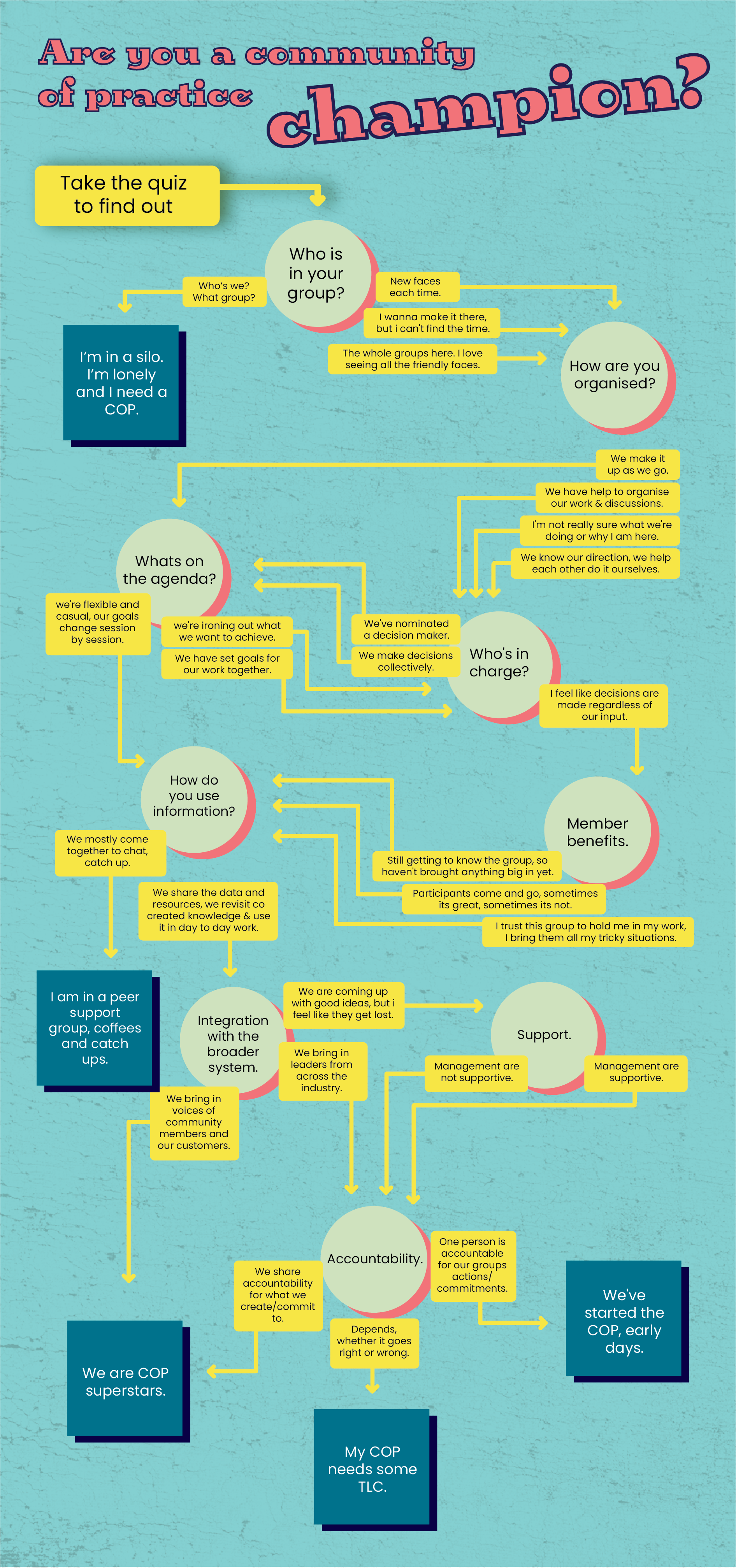
Are you a Community of Practice champion?
Just getting started or already have a CoP up and running?
Take this 2-minute quiz to discover which stage you're in—and what to focus on next to keep the momentum going.